Heaven Connect curates here articles, experience reports and background knowledge on mediumship, trance mediums, afterlife contact and grief support. All content is from external sources – the links lead directly there.
In this episode of BR's Stationen series, the question is explored whether contact with the deceased is real or rooted in human wishful thinking. The programme features people with near-death experiences, mediums – including the well-known medium Anna Stetskamp – and critical voices from science and the church.
Presentation of the research findings of Italian consciousness researcher Dr. Patrizio Tressoldi (University of Padua) on the accuracy of mediumistic messages. In controlled studies, Tressoldi examines whether mediums can convey information about the deceased that they could not have known by normal means.
Prof. Dr. Oliver Lazar in conversation with the well-known Swiss medium Pascal Voggenhuber about the aura, its perception and significance in mediumistic work. Voggenhuber is one of the most prominent mediums in the German-speaking world and shares practical insights into his perceptions.
Live documentation of a mediumship reading: the well-known medium Bettina Suvi Rode delivers messages from the deceased to family members present. The recording provides an authentic impression of the flow of a session and the reactions of the participants.
Portrait and tribute to the well-known Swiss medium Sam Hess, produced by the specialized channel Thanatos TV. Hess talks about his work as a medium, the nature of the spirit world and the process of mediumistic conversations with the deceased.
Short portrait of Swiss medium Sam Hess, who passed away in 2025, produced by Thanatos TV. In just a few minutes, Hess sums up his central conviction: there is no death – consciousness continues to exist after the body passes away.
In-depth interview with Swiss medium Pascal Voggenhuber. He talks about how he discovered his gift, how a typical mediumship reading unfolds and which experiences shape his work with grieving relatives. Produced by MYSTICA Magazin.
Portrait documentary about the spiritual medium Ira Wolff. She gives personal insights into her life between everyday reality and the spirit world, talks about formative encounters with the deceased and describes how her mediumistic perception has developed.
Extended interview with Pascal Voggenhuber on the channel Welt im Wandel.TV. Voggenhuber explains how mediumship readings work in practice, answers typical questions and talks about consciousness after death from the perspective of an experienced medium.
Excerpt from the Welt im Wandel.TV interview (starting at 20:47): Pascal Voggenhuber explains that he has been working with Swiss police since 2002. In his first murder case he provided – via a reading with the victim – details that he could not have known by normal means. About 90 % of his police work is recorded on video to convince sceptical officers. He outlines typical use cases: aura reading during interrogations to detect lies, reconstructing witness blackouts, energetic readings of crime scenes (course of events, DNA traces, number of perpetrators) and offender profiles – comparable to a profiler, but in hours rather than months.
Historic interview from 1981 with death researcher Elisabeth Kübler-Ross, one of the pioneers of modern thanatology. She reports on her conversations with dying people and the recurring patterns in their near-death experiences.
Interview with the Aachen-based physician and scientist Professor Walter van Laack, who has researched near-death experiences for decades. Van Laack says he personally no longer fears death and is convinced that consciousness continues after death "without pause or comma". Core points: standard explanations (oxygen deprivation, drugs, hallucinations) "fall short across the board". There are documented cases of NDEs during flat-line EEG – i.e. without measurable brain activity. More than 95 % of experiences are positive, people lose their fear of death and often become more spiritual and less materialistic. The "common thread" across all eras and cultures clearly distinguishes NDEs from dreams or drug hallucinations.
First part of a three-part documentary on near-death experiences and journeys beyond. Those affected report on their experiences at the border of death: the tunnel, the light, encounters with the deceased and the return to life.
In-depth conversation with neurologist Wilfried Kuhn on Thanatos TV. Kuhn examines near-death experiences, consciousness and the question of life after death from a neuroscientific perspective and discusses what can be medically explained and what goes beyond that.
Philosopher Godehard Brüntrup (Munich School of Philosophy) analyzes near-death experiences from a philosophical perspective. He discusses what NDEs mean for the mind-body problem and the question of the persistence of consciousness, and weighs materialist and dualist explanatory approaches against each other.
Interview with Swiss medium Sam Hess on the channel Empirische Jenseitsforschung. Drawing on his many years of practice, Hess describes what encounters with spirits of the deceased feel like, how he distinguishes between his own thoughts and mediumistic impressions, and which stories have particularly shaped him.
Swiss medium Sam Hess speaks in this interview, with great care, about the consequences of suicide from the perspective of the spirit world, and about how those left behind can deal with this difficult experience. English and French subtitles available.
Appearance of German medium Paul Meek on the RTL show Mysteries, hosted by Jörg Draeger. Meek demonstrates his work as a medium in front of an audience and talks about the process of delivering mediumistic messages to relatives of the deceased.
An episode of the renowned SRF series Sternstunde Religion explores what mediums do when they deliver messages from the deceased. The well-known Swiss medium Dolly Röschli speaks in dialogue with a skeptical pastor.
The channel Geist & Quantenphysik examines the unresolved death of German politician Uwe Barschel from the perspective of an afterlife contact conducted by the well-known medium Kim-Anne Jannes. The piece combines the historical facts of the case with statements that came through mediumistic communication – an insight into how afterlife contacts are linked to major real-world events.
Opening volume of the Lucy trilogy by the Heidelberg physicist and professor of medical technology Markolf H. Niemz. Niemz connects near-death experiences with Einstein's relativity theory and argues, in vivid terms, that the physics of the speed of light offers a plausible picture of what dying people experience. A science-minded approach to the question of life after death, carried by a fictional narrator named Lucy.
The second volume of the Lucy trilogy (Droemer, 2007) became a German-language bestseller. Niemz describes the "soul" as an immaterial storage medium that absorbs everything a living being feels and learns, and explains – with numerous self-drawn illustrations – what relativity theory and near-death experiences have in common. A hallmark of his approach is the bridge he tries to build between natural science and religion.
The third and final volume of the Lucy trilogy (Kreuz/Herder, 2011), also a bestseller. Niemz here condenses his reflections on life after death, the soul and the question of God from a physicist's perspective, inviting readers to a holistic way of thinking that links natural science, spirituality and religion. With the proceeds from the trilogy Niemz founded the charitable foundation Stiftung Lucys Kinder.
Recording of a public mediumship evening with Annette Meng (pink spirit) in Heidelberg, Germany. The video captures afterlife contacts demonstrated live in front of an audience – an authentic glimpse into how a medium works and how participants react when personal messages from the deceased are conveyed.
In the podcast {ungeskriptet}, host Ben talks with the medium Brigit Fischer – currently one of the best-known mediums in the German-speaking world – about her work, her self-perception and her outlook for 2026. A personal, conversational interview that presents the perspective of a practicing seer – her methods and her experiences.
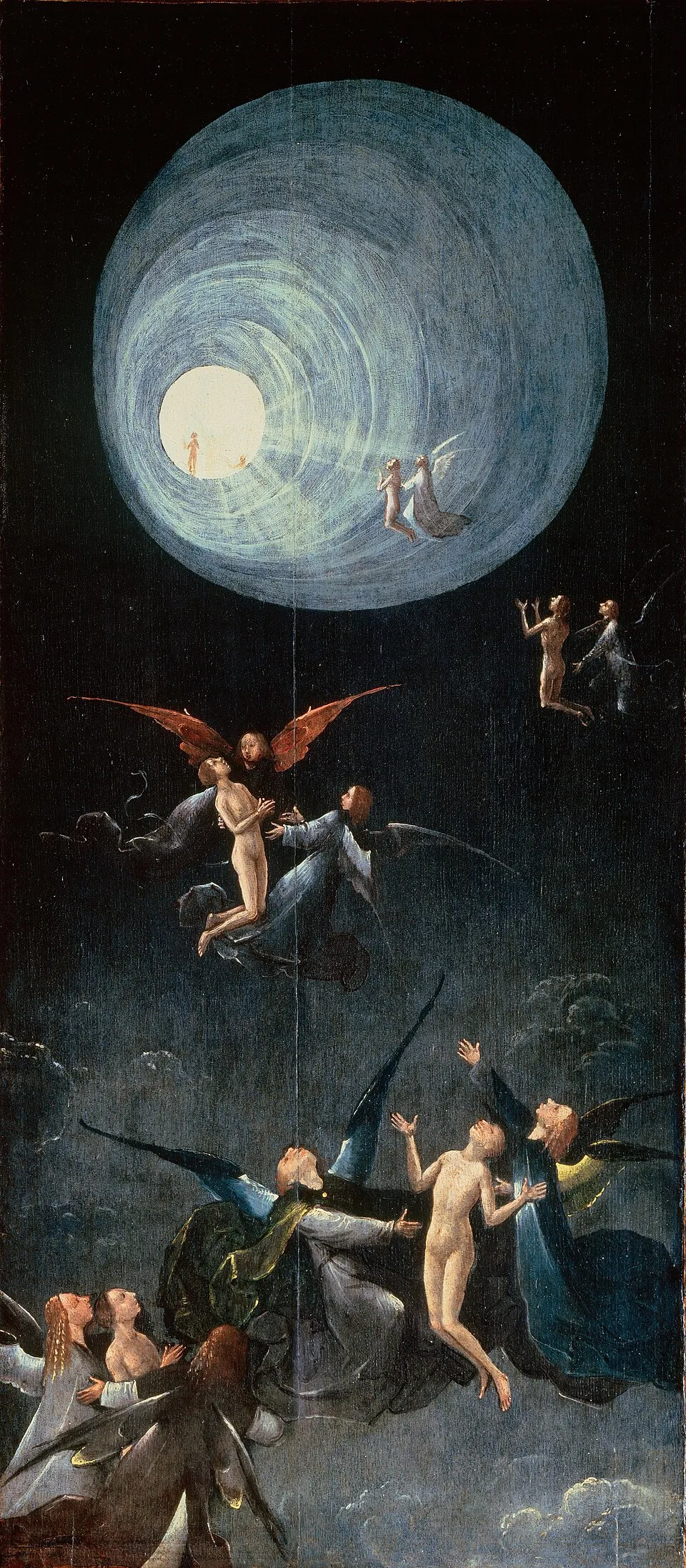
Ascent of the Blessed to Heavenly Paradise – Hieronymus Bosch
Hieronymus Bosch, "Ascent of the Blessed" (c. 1500) – public domain, via Wikimedia Commons
The panel "Ascent of the Blessed to Heavenly Paradise" by Hieronymus Bosch (c. 1500, today at the Doge's Palace in Venice) depicts departed souls ascending – accompanied by angels – through a bright tunnel into the beyond. The tunnel-and-light motif is still cited in connection with near-death experiences and counts as one of the earliest pictorial representations of what would centuries later be described as a core NDE motif.
Arts & Culture·Fairy tale, 1845
The Little Match Girl – Hans Christian Andersen
Andersen's 1845 Christmas tale ends with a classic transition motif: the already-deceased grandmother appears to the dying child "clear and shining, yet mild and loving", takes her in her arms, and the two "fly upwards in brightness and joy" – as cold, hunger and pain fall away. The same pattern – being received by a loved one who has already died – appears in contemporary near-death reports and in the practice of professional mediums.
Selected key scenes from the Hollywood classic Ghost (1990) starring Patrick Swayze and Demi Moore. More than almost any other film, Ghost has shaped the popular cultural image of afterlife contact and spirit communication through a medium – worth watching as an entry point into the mainstream portrayal of the topic.
The legendary séance scene from Ghost (1990) featuring Whoopi Goldberg as the medium Oda Mae Brown. The scene is a powerful example of how Hollywood portrays mediumistic contact with the deceased – both comedic and moving, and to this day one of the most iconic depictions of afterlife contact on film.
The moment from Ghost (1990) when Sam realises he has died and now exists as a spirit between worlds. Cinematically, this scene is one of the most striking depictions of the transition into the afterlife state and illustrates how coming to terms with one's own death can be portrayed on screen.
An English-language film recap of the classic Ghost (1990). The summary retells the story of Sam, who remains as a spirit after his murder and refuses to cross over into the afterlife until his death is solved – a compact overview of how the motif of the unredeemed spirit and communication through a medium is dealt with in pop culture.
English-language film recap of "The House of the Spirits" (1993), the adaptation of Isabel Allende's 1982 novel starring Meryl Streep, Jeremy Irons, Glenn Close, Winona Ryder and Antonio Banderas. At its centre is the clairvoyant Clara, a natural medium: she has premonitions, moves objects by telekinesis and communicates with the dead. The film follows three generations of a Chilean family and portrays mediumship as a self-evident, inherited gift – one of the best-known literary depictions of female clairvoyance in the 20th century.
2014 Swiss episode of the Tatort crime series: Lucerne detectives Flückiger and Ritschart receive help from the medium "Pablo Guggisberg" during their investigation. According to the Luzerner Zeitung, the character is modelled on Swiss medium Pascal Voggenhuber. Voggenhuber has confirmed in interviews that he worked for the Swiss police for years, helping to solve – among other things – murder cases. The episode is a telling example of how mediumship and afterlife contact are handled in German-language pop culture.
Excerpt from the ZDF talk show "Johannes B. Kerner" (2004), featuring author Alexa Kriele among the guests. Kriele describes herself as an angel interpreter and talks about how she receives and translates messages from the spiritual realm. She is one of the best-known German-speaking voices on angel and mediumistic work and has published numerous books on these topics.
In this interview with MYSTICA.TV, the medium Anouk Claes talks about clairvoyance, the role of the ego in mediumistic work, and how to deal with one's own emotions. A deep insight into the inner attitude required to distinguish clear mediumistic perceptions from personal projections.
In this MYSTICA.TV interview, the medium Anouk Claes explores whether clairvoyance is an innate gift or a skill that can be learned. She describes the path towards developing one's own mediumistic perception, the exercises required and common pitfalls – a helpful orientation for anyone wondering whether mediumistic work is open to them.
A portrait documentary in the renowned SRF DOK series about the medium Anouk Claes. The film follows her in everyday life and shows how she interprets her clairvoyant perceptions and uses them professionally in her work – a rare, in-depth glimpse into the life of a medium, produced by Swiss public television.
Dutch cardiologist Dr. Pim van Lommel presents his highly regarded research into near-death experiences (NDE) in resuscitated cardiac patients. His studies, published among others in The Lancet, are considered a milestone in consciousness research and provide evidence that consciousness may persist during clinical death states – a scientifically grounded starting point for the discussion about continued existence after death.
English-language interview with Dutch cardiologist Dr. Pim van Lommel on Conor Ryan's Eyes Wide Open podcast. Van Lommel speaks at length about his decades of research into near-death experiences in cardiac patients and the implications for our understanding of consciousness and life after death.
In this MYSTICA.TV interview, Varda Hasselmann – one of the best-known German-speaking trance mediums – talks about her work as a conscious deep-trance medium. She describes how she enters the trance state, what distinguishes conscious deep-trance from classical trance, and the experiences she has gathered over decades of working with the spirit world.
Prof. Dr. Oliver Lazar presents the research of US parapsychologist Dr. Julie Beischel of the Windbridge Research Center. The focus is on her controlled studies of the so-called survival hypothesis – the question of whether consciousness survives bodily death – and the methodology she uses to test the accuracy of mediumistic messages under scientific conditions.
Lecture by intensive-care physician and near-death researcher Dr. Sam Parnia (Stony Brook University) at the University of Chicago. Parnia led the AWARE studies, which systematically document near-death experiences in patients after cardiac arrest. He discusses what happens in the brain during clinical death, what reports resuscitated patients provide, and what this means for our understanding of consciousness and dying.
Interview with intensive-care physician and near-death researcher Dr. Sam Parnia in the renowned science and philosophy series Closer To Truth by Robert Lawrence Kuhn. Parnia discusses whether persons have souls and what medical research into near-death states of consciousness can say about this question – a concise, scientifically grounded entry point into the topic.